
Large Language Models (LLMs) have fundamentally changed how we build internal business applications. They allow developers to create intelligent software that can synthesize complex corporate data, answer internal queries, and automate repetitive workflows.
But moving an LLM application from a local prototype to a production enterprise system can reveal a critical reliability issue: overconfidence.
Standard language models are optimized to generate the most statistically probable next token, not to evaluate their own baseline certainty. When confronted with ambiguous prompts, incomplete retrieval context, or out-of-domain edge cases, an unguarded model will confidently invent plausible-sounding falsehoods, hallucinating facts without giving the user any indication of uncertainty.
In mission-critical enterprise environments, an AI application that guesses blindly is a severe business risk. In this guide, you'll learn how to build a production-grade uncertainty framework. I'll walk you through an architecture designed to detect knowledge gaps, compute probabilistic confidence metrics, and gracefully route low-certainty requests to human operators or safe fallback responses.
What We'll Cover
Understanding the Enterprise Request Lifecycle for Uncertainty Evaluation
Operational Insights from Running Uncertainty Detection Systems
Prerequisites and Environment Setup
To follow this practical guide and run the implementation code locally, you should meet the following baseline requirements:
Proficiency in writing clean, structured Python code.
A foundational understanding of Retrieval-Augmented Generation (RAG) concepts and vector embeddings.
Python 3.9 or higher installed on your computer.
An integrated development environment such as Visual Studio Code.
Package Installation
Open your terminal and execute the following command to install the necessary external dependencies:
pip install openai sentence-transformers numpy python-dotenv
Local Directory Structure
Organize your workspace with a clean structure to keep execution reproducible:
uncertainty-engine/

│

├── .env

├── README.md

└── app.py
Environment Configuration
Create a .env file in the root directory of your project to store access credentials and threshold configurations:
Code snippet
OPENAI_API_KEY=your_actual_api_key_here
ENVIRONMENT=development
CONFIDENCE_THRESHOLD=0.75
The Challenge: Addressing the Overconfidence Vulnerability
Standard LLMs lack an internal mechanism to declare "I don't know." When a RAG application encounters missing documentation or receives an out-of-scope query, the core model treats the missing data as a text-completion puzzle to be solved at all costs.
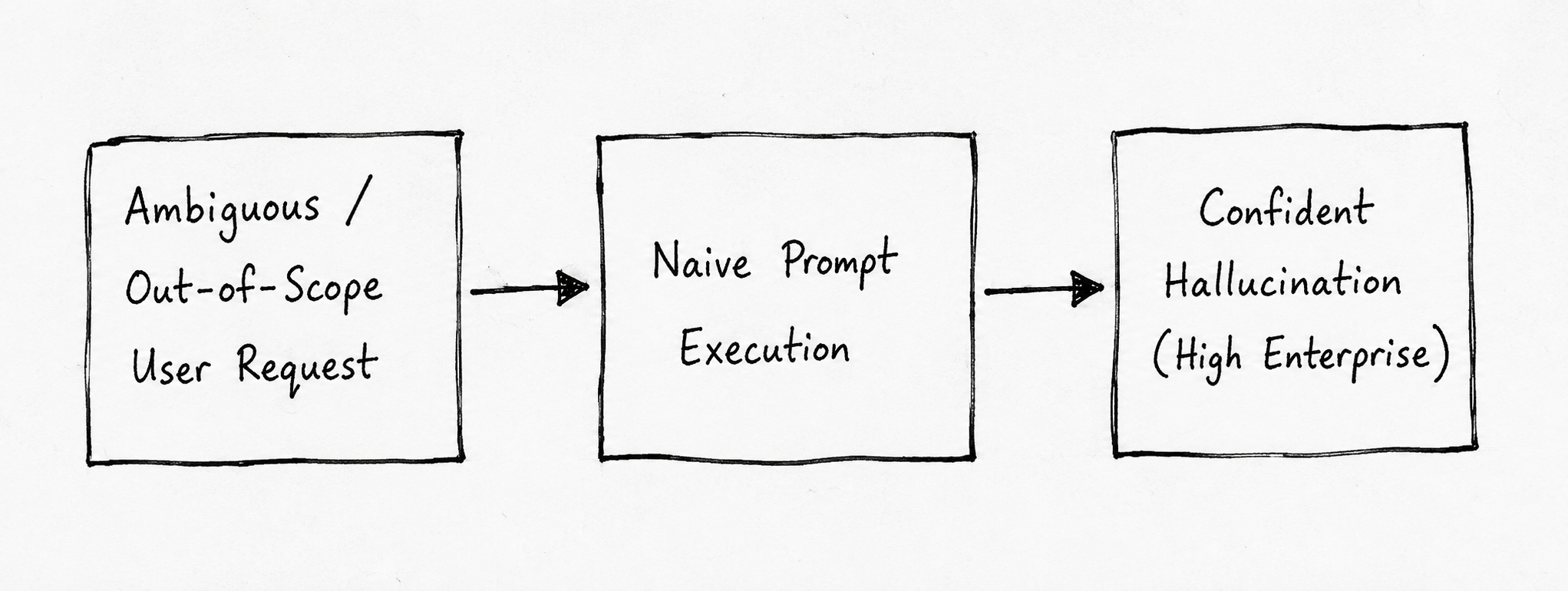
Figure 1: Vulnerability architecture of standard LLM pipelines, showing an ambiguous/out of scope request, followed by naive prompt execution, followed by confident hallucination.
Relying on system prompts like "Only answer if you are 100% sure" is ineffective because models easily bypass system prompt constraints when predicting token sequences. Enterprise systems require deterministic code boundaries that evaluate semantic relevance, document distance, and token probabilities independently of the LLM's raw output.
Understanding the Enterprise Request Lifecycle for Uncertainty Evaluation
To prevent uncalibrated outputs, we intercept requests using a deterministic request lifecycle. Every transaction travels through three validation layers before a final output is sent to the end user:
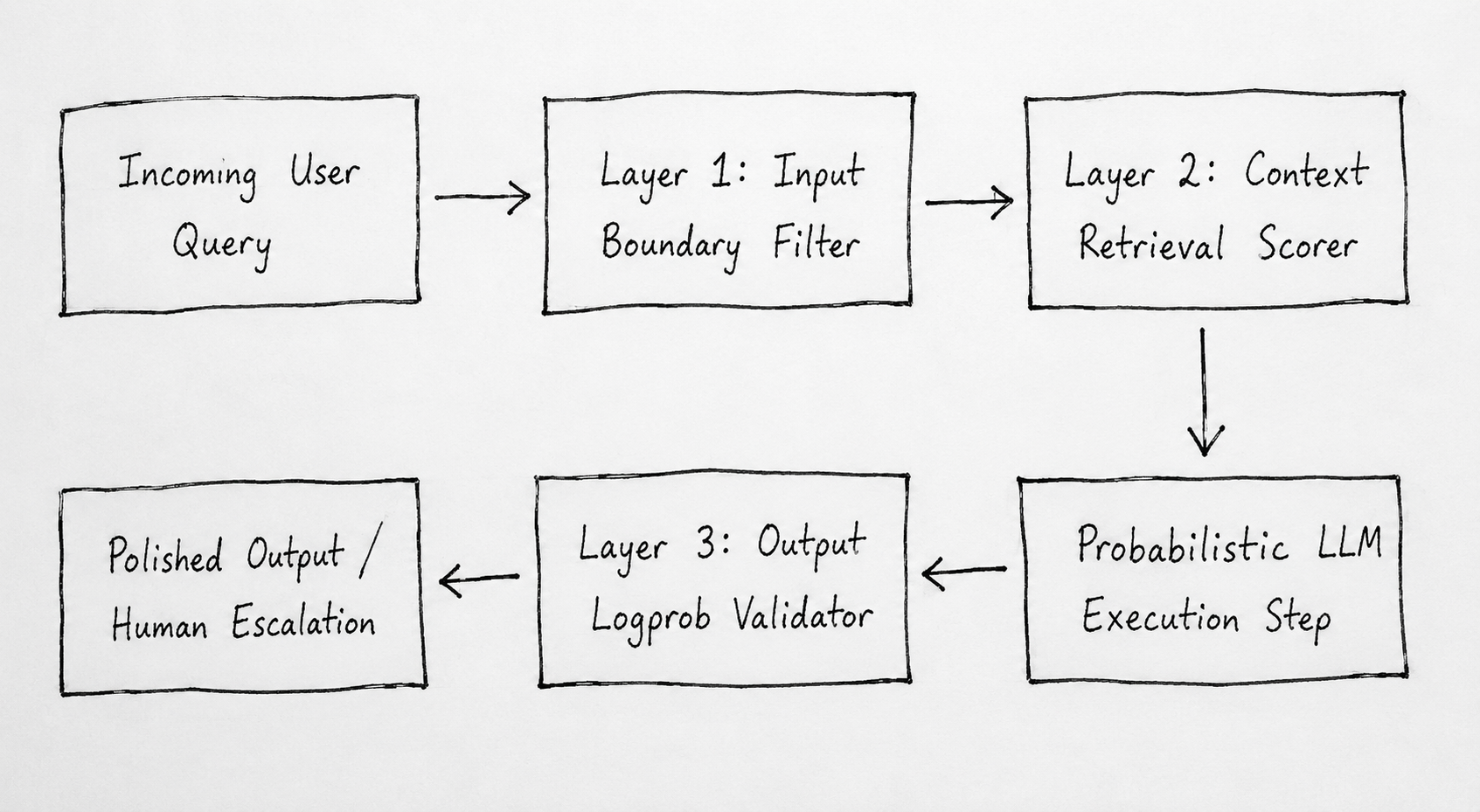
Figure 2: Safe enterprise LLM architecture with fallback escalation, showing a user request passing through input boundary validation, retrieval quality assessment, and output uncertainty checks before a response is delivered.
By decoupling safety decisions from the LLM, your code acts as the decision-making boundary while the language model operates strictly as an analytical generation engine.
Step 1: Implementing Layer 1 – Input Intent & Boundary Detection
The first defensive layer determines whether an incoming query falls within your system's valid domain parameters before calling retrieval pipelines or model APIs.
import numpy as np
from sentence_transformers import SentenceTransformer

class BoundaryDetector:
    def __init__(self, target_domains: list, similarity_threshold: float = 0.45):
        self.encoder = SentenceTransformer("all-MiniLM-L6-v2")
        self.domain_embeddings = self.encoder.encode(target_domains)
        self.threshold = similarity_threshold

    def verify_domain_relevance(self, query: str) -> dict:
        query_vector = self.encoder.encode([query])

        # Calculate cosine similarity against domain boundaries
        similarities = np.dot(self.domain_embeddings, query_vector.T) / (
            np.linalg.norm(self.domain_embeddings, axis=1, keepdims=True) * np.linalg.norm(query_vector)
        )
        max_similarity = float(np.max(similarities))

        if max_similarity < self.threshold:
            return {
                "is_valid": False,
                "score": round(max_similarity, 4),
                "reason": "Query falls outside operational domain boundaries."
            }

        return {
            "is_valid": True,
            "score": round(max_similarity, 4),
            "reason": "Query verified within target operational scope."
        }

if __name__ == "__main__":
    approved_topics = [
        "company VPN configuration",
        "employee payroll schedules",
        "internal IT software deployment"
    ]
    detector = BoundaryDetector(target_domains=approved_topics)
    out_of_scope_query = "What is the optimal baking temperature for sourdough bread?"
    result = detector.verify_domain_relevance(out_of_scope_query)
    print(f"Domain Validation Result: {result}")
This module converts approved operational topics into semantic vector embeddings. When a user submits a query, the script converts the input into an embedding vector and calculates its cosine similarity against defined domain bounds. If the alignment score sits below the threshold, the request stops immediately, saving API compute costs and preventing out-of-domain guessing.
Step 2: Implementing Layer 2 – Semantic Distance & Retrieval Quality Scoring
RAG platforms routinely hallucinate because vector retrieval engines return low-scoring document matches when relevant context is missing. We measure the semantic distance between the query and retrieved context chunks to verify retrieval quality
class RetrievalQualityScorer:
    def __init__(self, minimum_relevance: float = 0.60):
        self.encoder = SentenceTransformer("all-MiniLM-L6-v2")
        self.min_relevance = minimum_relevance

    def evaluate_retrieved_context(self, user_query: str, retrieved_chunks: list) -> tuple:
        if not retrieved_chunks:
            return False, 0.0

        query_vec = self.encoder.encode(user_query)
        chunk_vecs = self.encoder.encode(retrieved_chunks)

        # Compute cosine similarity across retrieved chunks
        scores = np.dot(chunk_vecs, query_vec) / (
            np.linalg.norm(chunk_vecs, axis=1) * np.linalg.norm(query_vec)
        )
        top_score = float(np.max(scores))

        is_sufficient = top_score >= self.min_relevance
        return is_sufficient, round(top_score, 4)

if __name__ == "__main__":
    scorer = RetrievalQualityScorer()
    sample_query = "How do I configure mutual TLS for gRPC services?"
    sample_context = [
        "Standard deployment uses isolated network clusters with automated releases."
    ]
    has_context, score = scorer.evaluate_retrieved_context(sample_query, sample_context)
    print(f"Context Sufficient: {has_context} | Top Match Score: {score}")
This step converts retrieved document chunks into vector embeddings alongside the user query to compute individual similarity scores. If the highest-scoring chunk fails to cross the minimum relevance threshold, the module flags the context as insufficient, blocking the system from sending irrelevant text to the model.
Step 3: Implementing Layer 3 – Probabilistic Logit Analysis & Output Validation
The final layer inspects token generation probabilities (log probabilities) returned by model APIs. When an LLM is unsure of its answers, token distribution entropy increases, revealing uncertainty directly in the API payload.
import math

class OutputLogprobValidator:
    def __init__(self, logprob_threshold: float = -0.35):
        self.threshold = logprob_threshold

    def evaluate_token_certainty(self, token_logprobs: list) -> dict:
        if not token_logprobs:
            return {"is_confident": False, "avg_logprob": -1.0, "perplexity": 999.0}

        avg_logprob = sum(token_logprobs) / len(token_logprobs)
        perplexity = math.exp(-avg_logprob)
        is_confident = avg_logprob >= self.threshold

        return {
            "is_confident": is_confident,
            "avg_logprob": round(avg_logprob, 4),
            "perplexity": round(perplexity, 4)
        }

if __name__ == "__main__":
    validator = OutputLogprobValidator()
    # Simulated logprob arrays from an API output
    unconfident_logprobs = [-0.12, -0.85, -1.20, -0.45, -0.95]
    result = validator.evaluate_token_certainty(unconfident_logprobs)
    print(f"Generation Certainty Assessment: {result}")
This class processes the raw log probabilities of generated tokens to compute an average logprob metric alongside text perplexity. By comparing this value against a calibrated threshold, the application objectively determines whether the model was uncertain during text generation.
Integrating the Verification Layers into a Single Pipeline
We now unify these three isolated verification modules into a single orchestration engine that governs the enterprise request pipeline end-to-end.
class EnterpriseUncertaintyEngine:
    def __init__(self, approved_domains: list):
        self.boundary_layer = BoundaryDetector(target_domains=approved_domains)
        self.retrieval_layer = RetrievalQualityScorer()
        self.output_layer = OutputLogprobValidator()

    def process_request(self, user_query: str, retrieved_docs: list) -> str:
        print(f"\n--- Processing Query: '{user_query}' ---")

        # Check 1: Input Boundary Evaluation
        boundary_result = self.boundary_layer.verify_domain_relevance(user_query)
        if not boundary_result["is_valid"]:
            return f"Request Rejected: {boundary_result['reason']}"
        print("[Pass] Input verified within operational domain.")

        # Check 2: Retrieval Context Quality
        valid_context, ret_score = self.retrieval_layer.evaluate_retrieved_context(user_query, retrieved_docs)
        if not valid_context:
            return f"Escalated: Insufficient ground-truth data retrieved (Score: {ret_score}). Routing to support team."
        print(f"[Pass] Context quality validated (Score: {ret_score}).")

        # Step 3: Simulated LLM Generation & Logprob Verification
        # In production, replace dummy logprobs with actual API responses
        simulated_logprobs = [-0.08, -0.05, -0.12, -0.04]
        certainty = self.output_layer.evaluate_token_certainty(simulated_logprobs)

        if not certainty["is_confident"]:
            return "Fallback Active: Generated output exhibited low token certainty."
        print(f"[Pass] Output probability verified (Avg Logprob: {certainty['avg_logprob']}).")

        return "Response Generated: Navigate to portal.company.internal to reset your VPN credentials."

if __name__ == "__main__":
    domains = ["VPN credentials", "software provisioning", "network settings"]
    engine = EnterpriseUncertaintyEngine(approved_domains=domains)

    # Test Case: Query with valid retrieved context
    context_data = ["To update VPN credentials, access portal.company.internal."]
    final_output = engine.process_request("How do I update my VPN password?", context_data)
    print(f"System Output: {final_output}")
This orchestration class combines input validation, retrieval scoring, and logprob checking into a single execution workflow. It routes requests through each verification checkpoint sequentially, blocking out-of-domain queries, escalating under-retrieved contexts to human support, and filtering low-probability generations.
Operational Insights from Running Uncertainty Detection Systems
Designing uncertainty-aware LLM architectures yields several practical deployment lessons:
Decouple confidence checks from system prompts: Avoid asking the model "Are you confident in this answer?" inside prompt context. Models frequently generate high self-reported confidence for incorrect statements. Use mathematical indicators like logprobs and vector distances instead.
Establish clear escalation workflows: Treat "I don't know" as an intentional operational outcome rather than a code failure. Route low-confidence queries directly to internal ticketing queues or human-in-the-loop (HITL) review channels.
Monitor retrieval metrics for knowledge gaps: Track and aggregate requests that fail retrieval scoring. Low-relevance metrics highlight missing, outdated, or poorly indexed corporate documentation.
Tune similarity thresholds continuously: Embedding distance metrics are sensitive to document length and vocabulary choices. Periodically evaluate sample system logs to adjust relevance boundaries for optimal precision.
Conclusion
Building production-grade AI applications requires transitioning from naïve prompt engineering to a security-first engineering mindset. While Large Language Models provide powerful natural language capabilities, they're uncalibrated tools that can't natively measure truth or certainty.
By wrapping models in deterministic code boundaries that evaluate input intent, document relevance, and generation probabilities, you transform an unpredictable language model into a reliable enterprise platform: one that delivers helpful answers when confident and knows exactly when to say "I don't know."
Thank you for reading.
I hope this guide offers a clear framework for building uncertainty-aware AI applications within your enterprise environments.
If you would like to discuss AI engineering, Agentic architectures, LLM ops, or AI governance, feel free to connect with me:


